Wednesday, February 9, 2011

The Devotion of Friends

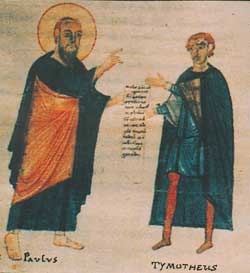
The second reading for the Morning Office today (2 Timothy 1:15-2:13) is touching excerpt from St. Paul to his "beloved child", Timothy.

"You are aware that all who are in Asia have turned away from me, including Phygelus and Hermogenes. May the Lord grant mercy to the household of Onesiphorus, because he often refreshed me and was not ashamed of my chain; when he arrived in Rome, he eagerly searched for me and found me—may the Lord grant that he will find mercy from the Lord on that day! And you know very well how much service he rendered in Ephesus."
How hard it is for all of us when people whom you counted as friends "turn away" from you. It seems that, most of the time, the differences which separate us are extremely petty things, or at least thing which could be mutually worked through with a little patience and rationality. Sometimes the separations are because of deeply-felt, cherished or ingrained convictions and beliefs. Even here, I believe one could find ways to "agree to disagree" and maintain at least a basic friendship. Whatever it was between Paul and Phygelus and Hermogenes, it was serious and those departing felt that they had good reason. Shakespeare holds that "Parting is such sweet sorrow...". If it does nothing else, it helps us appreciate the ones in our lives who do care, people committed to sticking with us through thick and thin. Paul intimates that his friend, Onesiphorus, possibly recently deceased from what Paul intimates, was such a person. Not only was he not ashamed of Paul when Paul fell on hard times: he sought Paul out, "eagerly", and came to his aid. 


"You then, my child, be strong in the grace that is in Christ Jesus; and what you have heard from me through many witnesses entrust to faithful people who will be able to teach others as well. Share in suffering like a good soldier of Christ Jesus. No one serving in the army gets entangled in everyday affairs; the soldier’s aim is to please the enlisting officer. And in the case of an athlete, no one is crowned without competing according to the rules. It is the farmer who does the work who ought to have the first share of the crops. Think over what I say, for the Lord will give you understanding in all things."
Paul then addresses his friend and disciple, Timothy, and encourages him to continue to be the kind of friend to Paul that Onesiphorus was. Paul, though absent, urges and encourages Timothy in his ministry to depend, not on his own strength, but on the power of Christ Jesus. He wants Timothy to continue Paul's own work of passing on, entrusting, the living Word of good news to receptive people, "faithful" people, people on whom Timothy can count to, in their turn, pass on and entrust and teach the message of God's reign to others. Paul is very direct about the cost: Timothy will suffer. He'll need to struggle to keep focused on essentials and avoid getting bogged down in mundane, peripheral things. Like an athelete, in order to be successful, Timothy needs to operate according to "the rules". It will entail hard work, such as a farmer experiences when the push is on to sow, to tend, and then to gather in the crops. Devotion is what Timothy needs to develop and nurture, and that will come, Paul says, from God who is the source of it "in all things".

Remember Jesus Christ, raised from the dead, a descendant of David—that is my gospel, for which I suffer hardship, even to the point of being chained like a criminal. But the word of God is not chained. Therefore I endure everything for the sake of the elect, so that they may also obtain the salvation that is in Christ Jesus, with eternal glory. The saying is sure:
If we have died with him, we will also live with him;
if we endure, we will also reign with him;
if we deny him, he will also deny us;
if we are faithless, he remains faithful—
for he cannot deny himself."
 For Paul the "gospel" is not just a message, a word, but a Person: Jesus Christ, someone who was truly a human being: in fact, one whose forbear was the great King David himself; and someone who is the Risen Christ, who died and lives, who endured suffering and now reigns, whose very essence is faithfulness, dependability, friendship and love. In essence, Paul is reminding Timothy: "What a friend we have in Jesus...", unlike Phygelus and Hermogenes, but so like Onesiphorus, one who'll never turn away.

Tuesday, February 8, 2011

"Even To Death Itself..."

O God our Father, source of strength to all your saints, you
brought the holy martyrs of Japan through the suffering of
the cross to the joys of eternal life: Grant that we,
encouraged by their example, may hold fast the faith we
profess, even to death itself; through Jesus Christ our Lord,
who lives and reigns with you and the Holy Spirit, one God,
now and for ever. Amen.

The Jesuits, led by St. Francis Xavier, then the Franciscans introduced Christianity to Japan in the 16th century. It's estimated that, by the end of the century, there were some 300,000 baptized Christians there.

Humans, however, being as they are, so frequently have minds of their own. Though Jesus said, "Wherever two or three are gathered together, there I am in the midst of them," more often than not human beings find ways to drive him out of their midst through jealousy, competition, turf-protecting, politics, and just plain meanness of spirit. So it was in Japan following the heroic efforts and self-giving of the early Christian missionaries. The Spanish vied with the Portuguese, and both vied with the Japanese. For a half century the powerful Tokugawa shoguns at least tolerated Christianity, but finally outlawed it, inflicting violent persecution and suppression.

20 converts and 6 Franciscan friars were the first to die at their hands, crucified at Nagasaki on February 5, 1597. Within 35 years Christians in Japan had been driven underground. Remarkably, in the 1880's it was discovered that many laity and clergy had admirably preserved a semblance of the Christian faith through many generations.

The recent witness of the citizens of Cairo, using their God-given rights of assembly and free speech to denounce oppression and injustice inflicted by civil rulers, have inspired many of us. They've demonstrated, sometimes painfully, very much like the Martyrs of Nagasaki, that there are some principles worth fighting and suffering for, "even to death itself".  Would we who profess to be Christians in our own country have the same determination and faith? Who knows but that there could come a time?...


Sunday, February 6, 2011

"In Much Fear and Trembling"


Three phrases jump out from the Epistle (1 Corinthians 2:1-16) and Gospel (Matthew 5-13-20) for this Sunday, Epiphany 5: 1) "fear and trembling; 2) "the salt of the earth"; 3) "the light of the world". The first one conjures up in my mind a well-worn joke which tells of a Jewish rabbi, a Roman Catholic priest, and an Episcopalian traveling together on a jetliner. In midair the plane suddenly drops some 1000 ft. within a few seconds, then stabilizes, and eventually lands safely. The news of the incident has preceded them to their destination, and a local news reporter is waiting at the gate to interview them and get their reactions to what happened. The Jewish rabbi explains that he prayed fervently to the God of Abraham, Isaac, and Jacob. The Roman priest tells the reporter that he prayed with almost equal gusto to the Blessed Virgin Mary to intercede with the Lord. "And to which denomination do you belong?" the reporter asks the third man. "I'm an E...copalian: I was an Episcopalian when I boarded the flight, but when the plane fell 1000 ft. in five seconds, that which is between the 'E' and the 'copalian' was sacred out of me, and now I'm an E...copalian!"

The passage from Paul's letter to the Corinthian community is particularly rich theologically and quite touching. "When I came to you, brothers and sisters, I did not come proclaiming to you the testimony of God in lofty words or wisdom. For I decided to know nothing among you except Jesus Christ and him crucified. And I was with you in weakness and in much fear and trembling..." One would have to look hard to find a more eloquent expression of humility, as well as an accurate summary and personal confession of Christian faith. For Paul, the vehicle for expressing such a deep reality was something far beyond any human "speech" or "message" or "plausible words of wisdom". For him only a "demonstration of the Spirit and of power" would do, in order that "your faith  might...rest...in the power of God."

None of the "rulers of this age" comprehend this. The powers that be in every age simply don't operate in that "universe" or according to those categories. The very fact that Jesus, "the Lord of glory", was crucified, murdered, in the way that he was is evidence of this. Paul then makes an astounding statement: that"'what no eye has seen, nor ear heard, nor the heart of man conceived, what God has prepared for those who love him', God has revealed to us through the Spirit...Now we have received...the Spirit which is from God, that we might understand the gifts bestowed on us by God. And we impart this in words not taught by human wisdom but taught by the Spirit, interpreting spiritual truths to those who possess the Spirit..."

In other words, sent to this community of believers in Jesus, Paul comes embodying in his person lowliness, weakness, inadequacy, yet also firm in the conviction that, by the power of the Spirit of Jesus, given as sheer gift from the Father, he, Paul, also embodies in his person an understanding of God's gift of "a secret and hidden wisdom", which he's passing on to them whose hearts have been open enough to receive and possess that same Spirit of power. They now, and this is where today's Epistle and Gospel connect, become "salt of the earth", "light to the world", embodying the same gift in themselves, called and commissioned to share it with those around them. To the powers that be and to those who fail to grasp this, these realities are the utmost "folly".

In this passage, Paul uses the word "wisdom" some six times. Scholars and theologians through the centuries, among them some of the great Russian writers and, of course, Thomas Merton in our own time, have sought to comprehend the meaning of "Holy Wisdom". Christopher Pramuk, in his recent book Sophia: The Hidden Christ of Thomas Merton, has provided, to my mind, one of the clearest synopses of that term.  He says: "Who then is Hagia Sophia [Holy Wisdom]? She is the Spirit of Christ but more than Christ. She is the Love joining the Father, Son, and Spirit that longs for incarnation from before the very beginning. She is Jesus our mother, and Mary, the Theotokos. She is the 'pivot' (le point vierge) of nature, Natura naturans, and all creation in God from the beginning. Perhaps most of all, Merton's Sophia is our 'true self', when we (like Mary, seat of Wisdom) allow Christ to be birthed in us, and so realize the hidden ground of mercy, creativity, and presence in our very selves, the mystical Body of Christ..."

Paul understood, by the Spirit's enlightening, that Jesus' passion and death embodies a mystery which can be approached only in the realm of paradox, as a reality which Merton terms "negatively positive". In his Contemplation In a World of Action, Merton says that we must approach the cross "humbly and resolutely, following the call of God and obedient to the divine Spirit, like Moses approaching the burning bush, removing the 'shoes' of opinion and rationalization." In the ongoing act of creation God's Self-giving is both Self-emptying and Life-giving. Jesus, too, is non-violent "even to death on a cross", reconciling humans with God and with one another, ever inviting them to repent and change, asking forgiveness even for the very ones who killed him. In Merton's words, "Love cannot come of emptiness. It is full of reality."(Emblems of a Season of Fury)

Matthew's Jesus speaks of his disciples as "salt of the earth" and "light of the world". He makes clear that if the salt is flat, it's useless. There needs to be new salt. And if you're hiding your light from others, for whatever reason, you're violating the nature of light. Under normal circumstances, for example, it's impossible for an inhabited city on a hill to be hidden: you can see it in daylight and the lights at night give it away. Likewise, you don't light a lamp, then try to keep it hidden, but you elevate it so that the light can pervade the surrounding area. So with the disciples: if people can't see the "light" of good works embodied in you, the Father's free and lavish gifts, which those good works are, won't be celebrated and held up for imitation. In fact, their lack will put shame back on the Father.

Living according to the "spiritual wisdom" which Paul talks about is the real "Law of Christ", not human regulations or expectations. We who have been given the gifts of God's Wisdom must do and teach, else we can never claim to be participants in the reign of God in Christ.

The issues with which the Scriptures today challenge you and me are truly profound, if you think about them. Who wouldn't experience some semblance of "fear and trembling", mostly because we may begin to plumb the depths of the vast chasm between the Divine and us? We become vividly aware of how unequal to the task we might be. Sometimes, too, we're fearful simply that God may ask something of us, and we're fearful at what or how much God might ask.

Daniel Evans writes this about fear:
"It's so easy to be afraid, to be made afraid. Once it has happened, we find it difficult to ease back into the confidence that cancels fear and its power...

My little boy staggers to my bedside in the middle of the night, crying. A dream, a noise, a shadow has awakened him and awakened fear in him. I say 'Don't be afraid: it won't hurt you.' But I wonder if he believes me. I lead him back into the dark room, and the lonely bed seems so far away from mine. Can I love away the noise, the shadow, the dream in those silent, sleepy moments? Can I love the fear away?

When shall we awaken to the knowledge that that is what God has done for us? God has met us in the awful night. God wraps us in sympathizing love and assures us that we can trust the love of the Eternal more than all the darkness."

Friday, February 4, 2011

Courage In the "Day of Small Things"

St. Anskar [Ansgarius/Ansgar] (c. 801-865) was one of the first missionaries to the notorious Vikings, though he was himself a native of Picardy. Nevertheless, he's highly honored today by Danish, Swedish and Norwegian descendants of the Vikings, particularly in Sweden where he's said to have established the first Christian church in the 830's.

Anskar was orphaned at age 4, upon the death of his mother, and sent to the Monastery of Corbie, near Amiens. At the tender age of 13 he made his monastic profession and was educated there. Apparently he showed outstanding teaching skills because he was chosen as master of the New Corbie monastery school in Saxon Germany when he was 21. For years even before this, however, Anskar had experienced the desire and call to be a missionary. As it turned out, it wasn't he who actively searched out missionary opportunities. Rather, according to his biographer and friend, Rimbert/Rembert, the call came from various civil leaders, first King Harold of Denmark, and later Emperor Louis and others.

In 826 Anskar was invited to come to Denmark by King Harold, who had met Anskar when he stopped at the monastery while returning from exile. Anskar was able to establish a school and a mission in Denmark, and became noted as a popular preacher and holy man. Around 829, at the invitation of King Björn, Anskar journeyed to a merchant settlement, Birka, located in what is now the country of Sweden. Here, along with his faithful companion, Rimbert, he established the first Swedish church on the property of Herigar, a man whom he had converted.

Soon after, in 831, the Emperor Louis, by his own authority, appointed Anskar as abbot of New Corbie Monastery, then named him and had him consecrated as the first archbishop of Hamburg in 832. He also traveled to Rome that same year, where Pope Gregory IV appointed him as the papal legate of all the Scandinavian countries. He worked tirelessly for the next 14 years at Hamburg, establishing missions, building churches and libraries, in North Germany, Denmark, Sweden and Norway.

The Vikings overran the Scandinavian countries in 845, essentially decimating Hamburg and all that Anskar had: his church, monastery, library, etc. He transferred his operation to Bremen, over which the Pope also appointed him bishop, and continued his missionary efforts from there for the next 20 years.

The thing that particularly intrigues me about the feast of St. Anskar is the Collect for the day: "Almighty and everlasting God, you sent your servant Anskar as an apostle to the people of Scandinavia, and enabled him to lay a firm foundation for their conversion, though he did not see the results of his labors: Keep your Church from discouragement in the day of small things, knowing that when you have begun a good work you will bring it to a fruitful conclusion; through Jesus Christ our Lord, who lives and reigns with you and the Holy Spirit, one God, for ever and ever. Amen."
Most of us don't ever really see the results of our efforts. How easy it is to become discouraged when trying to live according to the Gospel each day. We lose sight of the fact that, after all, it's God's whose work is given to us and God who oversees the outcome and any "fruitful conclusion". Anskar had every human reason to gripe and complain and bemoan all his unappreciated years of missionizing people who didn't seem very open to it. Yet he courageously persisted "in the day of small things".

Rimbert writes this in his biography of Anskar: "...it is clear that there are two kinds of martyrdom: one occurs when the Church is at peace and is hidden from sight; the other occurs during times of persecution and is visible to all. Anskar desired both kinds of martyrdom, but in the end only attained one. For day after day, with tears, vigils, fasts, disciplining the flesh and mortifying his bodily desires, he offered up to God a sacrifice on the altar of his heart, and in so doing attained a martyrdom as far as is possible in a time of peace...He was indeed a martyr because the word 'martyr' means 'witness'. and he was a witness of God's word and of the name of Christ..."

St. Maria de Mattias (1805-1866)


Maria De Mattias was born in Vallecorsa Italy to a religious and upper class family which valued education. She was the second of four children born to Giovanni de Mattias and Ottavia de Angelis. Although women during her time did not receive a formal education, Maria nevertheless learned to read and write. In her midteens, she was withdrawn and focused more on her looks than on religion. But at age 16 she began a spiritual journey, inspired by a mystical vision which she'd had.

The great Roman missionary of the Precious Blood, St. Gaspar del Bufalo, visited her town in 1822. As Maria listened to his sharing of God's Word, she decided that she needed to devote her own life to teaching and spreading the Good News. On March 4, 1834, under the guidance of her spiritual director, Fr. Giovanni Merlini, also a missionary of the Precious Blood, she founded the Congregation of the Sisters Adorers of the Blood of Christ at the age of 29. During her lifetime, the order established over 70 communities in Europe. Maria died in Rome on August 20, 1866 at the age of 61 and was buried in Rome’s Verano Cemetery through the good graces of Pius IX.  She was declared Blessed in 1950 by Pope Pius XII, and was as a saint of the Church on May 18, 2003 by Pope John Paul II.

St. Maria de Mattias wrote: "For the triumph of his mercy and to show his infinite love for us, our divine Redeemer Jesus Christ shed all his precious Blood with great suffering and humiliation, as price of salvation and of glory. He gave it all, he gave it for all, and he does not stop giving it...This lowly Congregation which lives and labors under the glorious title of the most precious Blood of Jesus Christ must itself take on the shape and pattern of a living image of that divine love with which it was shed, and of which it was and is symbol, expression, measure and pledge. The spirit of this holy work is all love. We have carved this word in our minds and on our hearts. I repeat: Love! Love toward God and our dear neighbor...What a beautiful consolation it is to see spouses of the divine Lamb, the Adorers of his most precious Blood, motivated by one sole will, the will of God, forming but one heart and one soul, and thus unite, making the heavens resound with a hymn of thanksgiving to the infinite goodness of God, while at the same time they offer the Blood of his Son for the reconciliation of heaven with earth, of earth with heaven..."

Wednesday, February 2, 2011

The Meeting of the Lord

The Feast of the Presentation of Jesus in the Temple celebrates an early episode in his life. The Eastern Orthodox Church calls this feast, one of the twelve Great Feasts, the Hypapante = literally, the Meeting. It is also traditionally referred to as Candlemas, the Feast of the Purification of the Virgin, La Fête de la Chandeleur, and the Meeting of the Lord.

The Mosaic Law is clear in its prescriptions: "...you shall set apart to the Lord all that first opens the womb..." (Exodus 13:12)  "If a woman conceives and bears a male child, she shall be ceremonially unclean for seven days...Her time of blood purification shall be thirty-three days; she shall not touch any holy thing, or come into the sanctuary, until the days of her purification are completed...When the days of her purification are completed, whether for a son or for a daughter, she shall bring to the priest at the entrance of the tent of meeting a lamb in its first year for a burnt-offering, and a pigeon or a turtle-dove for a sin-offering...If she cannot afford a sheep, she shall take two turtle-doves or two pigeons, one for a burnt-offering and the other for a sin-offering; and the priest shall make atonement on her behalf, and she shall be clean."(Leviticus 12:2-8) St. Luke tells us that Joseph and Mary take the option provided for poor people.

Jesus' Presentation is described in Luke 2:22–40. To everyone's surprise, a devout old man, Simeon, full of the Holy Spirit, appears in the temple as the Holy Family enters. He's described as one who's been "waiting for the consolation of Israel". Seeing  Mary and Joseph with the infant, he takes Jesus into his arms and praises God: "‘Master, now you are dismissing your servant in peace, according to your word; for my eyes have seen your salvation, which you have prepared in the presence of all peoples, a light for revelation to the Gentiles and for glory to your people Israel.'" We know this today as the canticle, Nunc dimittis, used in Compline. Through the early ages of the Church it was sung, and candles blessed, lit, and carried in procession through the streets on the night of this feast. Thus, Candlemas in England and in other places: an ancient Feast of Lights.

Another figure in the Presentation scene emerges at the end of Luke's narrative: Anna, a prophetess, daughter of Phanuel of the tribe of Asher, of great age -- 84 -- and a widow. She'd been married to her husband for seven years, after which he died. Luke notes that "She never left the temple but worshiped there with fasting and prayer night and day..." 

The deacon and poet, St. Ephrem of Syria (c. 306-373), has left us a beautiful hymn describing the Presentation. He speaks of Simeon carrying Jesus and singing him a lullaby. He also says that
"Anna embraced the child; she placed her mouth 
upon his lips, and then the Spirit rested
upon her lips, like Isaiah
whose mouth was silent until a coal drew near
to his lips and opened his mouth.
She sang to him a lullaby:
'Royal Son,
despised son, being silent, you hear;
hidden, you see; concealed, you know;
God-man, glory to your name.'"

Sophronius, an Arab who was Patriarch of Jerusalem (634-638), bids his hearers in a sermon: "Let us all hasten to meet Christ, we who on honor and venerate the divine mystery we celebrate today. Everyone should be eager to join the procession to share in this meeting. Let no one refuse to carry a light. Our bright shining candles are a sign of the divine splendor of the One who comes to expel the dark shadows of evil and to make the whole universe radiat with the brilliance of his eternal light. Our candles also show how bright our souls should be when we go to meet Christ..." 

Blessed Guerric of Igny, 12th century Cistercian monk and abbot, also in a sermon, makes a touching suggestion to us who celebrate today's feast: "Behold then, the candle alight in Simeon's hands. You must light your own candles by enkindling them at his, those lamps which the Lord commanded you to bear in your hands. So come to him and be enlightened that you do not so much bear lamps as become them, shining within yourselves and radiating light to your neighbors. May there be a lamp in your heart, in your hand and in your mouth: let the lamp in your heart shine for yourself, the lamp in your hand and mouth shine for your neighbors. The lamp in your heart is a reverence for God inspired by faith; the lamp in your hand is the example of a good life; and the lamp in your mouth are the words of consolation you speak...My friends, in order to light all these lamps for yourselves, I beg you to approach the source of light and become enlightened -- I mean Jesus himself who shines in Simeon's hands to enlighten your faith, who shines in your works, who inspires your speech, who makes your prayer fervent and purifies the intentions of your heart..." 

Tuesday, February 1, 2011

St. Brigid/Bride of the Church of the Oak (d. c. 523)


Everliving God, we rejoice today in the fellowship of your blessed servant Brigid, and we give you thanks for her life of devoted service. Inspire us with life and light, and give us perseverance to serve you all our days; through Jesus Christ our Lord, who with you and the Holy Spirit lives and reigns, one God, for ever and ever. Amen.